

Investigations
Does Google Preferred Sources improve SEO?
A first-party investigation into what Google Preferred Sources changed for searchDecoded across ordinary results, AI Overviews, AI Mode and Top Stories.
What is Google Preferred Sources?
Google Preferred Sources lets a signed-in user choose websites they want to see more often in Google. Google says content from a selected source may be more likely to appear in Top Stories and may be highlighted in AI Overviews and AI Mode, so the preference changes one person’s Google experience rather than giving a website a ranking boost for everyone.
That hasn’t stopped some online coverage from describing Preferred Sources as an SEO ranking signal. The wording can sound persuasive if you’re deciding whether the feature deserves time or money, but being highlighted for someone who already chose your site is different from becoming easier for new people to find. searchDecoded tracked the feature for six weekly observations to see what actually happened.
Does Google Preferred Sources improve SEO?
This six-observation test didn’t show that Google Preferred Sources improves ordinary SEO rankings or reliably creates non-branded discovery. It showed a narrower yet still useful effect: Google can highlight a selected source for the person who chose it when that source appears on a supported surface.
The difference is between recognition and discovery. Recognition means making a familiar source more visible to someone who has already chosen it, while discovery means helping new people find the source through searches that don’t include its name. The test repeatedly showed branded recognition, while signs of non-branded discovery were rare and unstable.
What Google says Preferred Sources can change
Google’s Preferred Sources documentation says a selected site’s content is more likely to appear in Top Stories and can be highlighted in AI Overviews and AI Mode. The preference belongs to the signed-in user, so any change applies to that person’s experience rather than everyone searching Google.
Google’s consumer help page adds an important condition: sources that aren’t updated regularly may be unavailable, and fresh relevant content is more likely to appear in Top Stories. A website must also appear in Google’s source-selection tool before anyone can choose it, so checking whether your site is available there is the first practical step.
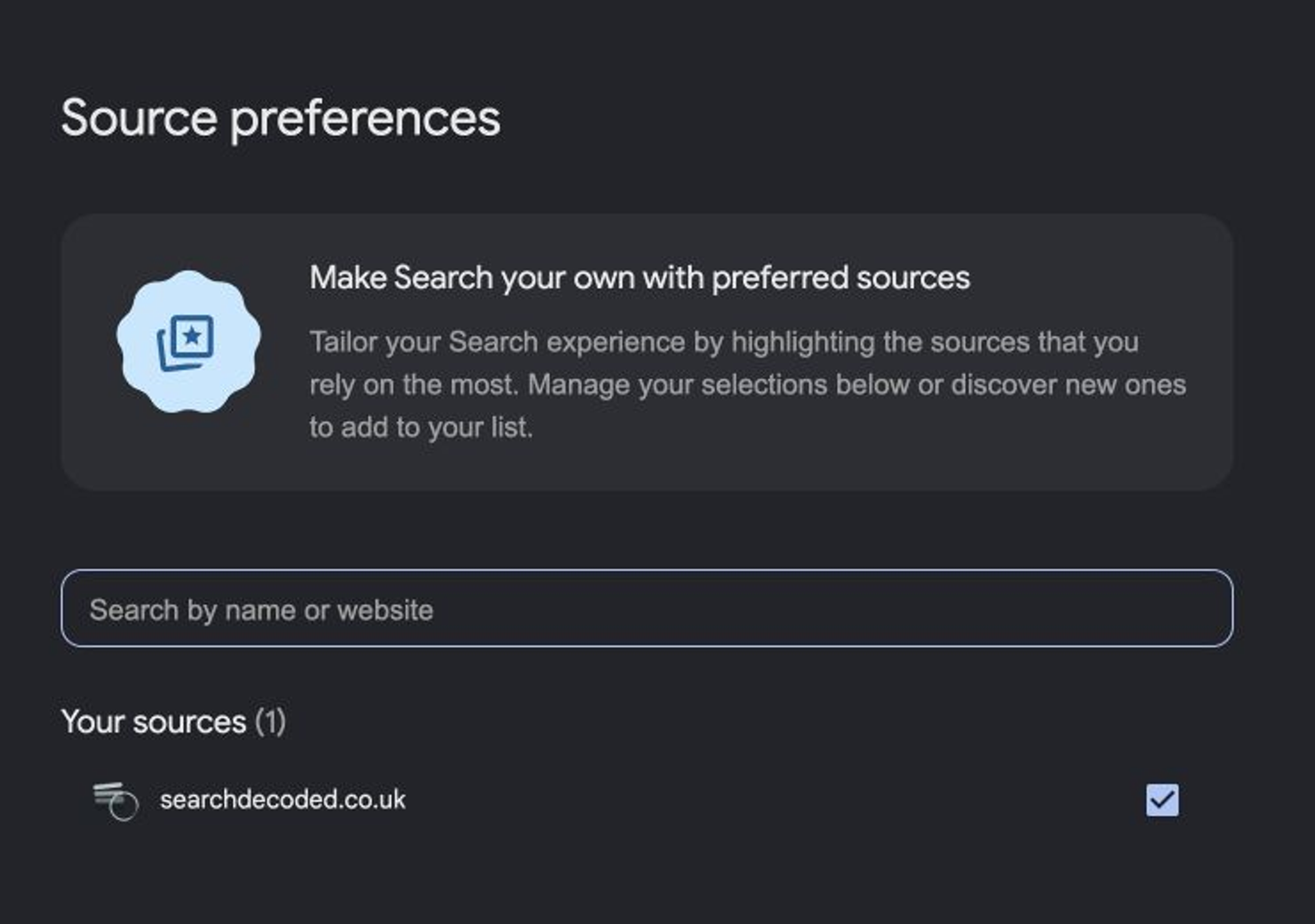
The feature isn’t restricted to a traditional newspaper or large publisher. A specialist website can qualify, as searchDecoded did, but qualification only makes the site selectable. It doesn’t guarantee that Google will show the site for a query or that the Preferred badge will appear every time.
What searchDecoded tested
searchDecoded was selected as a Preferred Source in one signed-in UK Google account. The same account, browser class and six-query set were checked on six weekly dates from 8 September to 13 October 2026. There were six observations in total, spanning five elapsed weeks.
The checks covered ordinary search results, AI Overviews and AI Mode when they appeared, plus Top Stories where available. They used the branded search ‘searchDecoded’ alongside five non-branded searches about schema markup, AI crawlers, AI Overviews, Google updates and SEO news.
searchDecoded continued publishing during the observation period, so any visibility change couldn't be isolated from the site's normal publishing activity or attributed to Preferred Sources alone.
What six weekly checks found
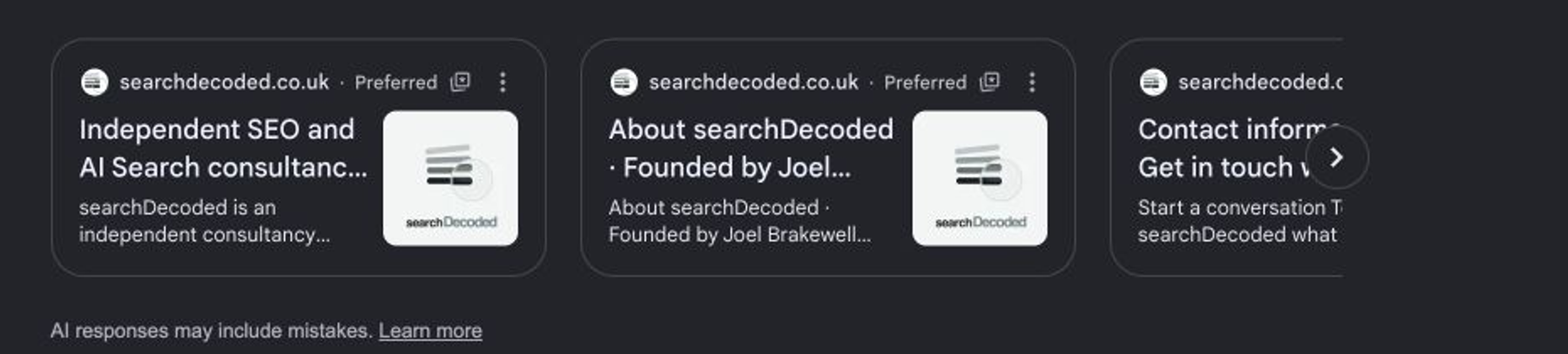
Branded highlighting was much more consistent than broader visibility. A branded AI Overview appeared in four of the six observations, and searchDecoded carried a Preferred badge on all four occasions.
AI Mode was less consistent. It cited searchDecoded for the branded query in three observations, but displayed the Preferred badge in only one of those three appearances. That variation shows why a single screenshot can’t describe the feature reliably.
| Observation | Result |
|---|---|
| Source selection and eligibility | Intact in all 6 observations. |
| Branded ordinary result | Homepage remained the leading result in all 6 observations. |
| Branded AI Overview | Appeared in 4 of 6 observations, with a Preferred badge in all 4 appearances. |
| Branded AI Mode | Cited searchDecoded in 3 of 6 observations, with a Preferred badge in 1 of those 3 appearances. |
| Non-branded ordinary results | searchDecoded appeared in 2 of 30 scheduled checks, both for the same schema query. One appearance disappeared on an immediate repeat. |
| Non-branded AI Mode | searchDecoded appeared in 1 of 30 scheduled checks and disappeared on an immediate repeat. |
| Top Stories for ‘SEO news’ | Top Stories appeared in all 6 observations, but searchDecoded appeared in none of them. |
The non-branded appearances were too rare and unstable to support a visibility claim. No Preferred badge appeared on any non-branded query, and searchDecoded was absent from every checked Top Stories result even though that surface appeared each week.
The branded finding shows that Google visibly applied the preference on some supported surfaces, but it doesn’t show that choosing searchDecoded caused the site to rank. The homepage already led the ordinary results for the brand name, and the experiment didn’t capture a comparable period before the source was selected.
The AI Overview badges are still useful evidence because they show Preferred Sources appearing beyond Top Stories for an independent site. They answer the narrow question of whether a selected independent source can be labelled as preferred, but they don’t answer whether the same page would have appeared without that choice.
What Google’s click claim can and can’t tell us
Google said in an April 2026 product update that people were twice as likely to click an article after marking its site as preferred. Google’s figure suggests the feature can help selected sources earn attention from readers who already value them, but it doesn’t tell you what will happen for an individual website.
searchDecoded couldn’t see which users had selected the site, which impressions carried a Preferred badge or whether a click followed that treatment. Google Search Console and Google Analytics therefore couldn’t isolate Preferred Sources exposure, clicks or business outcomes, so this experiment can’t confirm or challenge Google’s wider click finding. That wider reporting gap is explored in what Google Search Console’s AI report can tell you.
Is Google Preferred Sources worth using?
Google Preferred Sources may be worth making available to loyal readers, but it isn’t a substitute for broader SEO services or for the work that earns visibility over time. Its clearest use is with an audience you already have: someone who trusts your site can ask Google to make it easier to notice on supported surfaces.
Before putting much time into it, ask three questions:
- Does your website appear in Google’s Preferred Sources selection tool?
- Do you publish fresh material often enough for Top Stories or Google’s AI surfaces to be relevant?
- Do you have an existing audience that would recognise your name and choose it deliberately?
A simple mention to an established audience may be reasonable when all three answers are positive. Paying for a large campaign or technical project on the promise of higher general rankings would need stronger evidence, because this test didn’t show that outcome and Google’s documentation doesn’t promise it.
The first owner-level step is to check eligibility and decide whether source preference fits a real returning-reader relationship. If you do promote Preferred Sources, judge it against a goal such as encouraging repeat readership rather than expecting a general SEO boost.
What this investigation establishes
Across the six weekly checks, searchDecoded remained eligible and selected, while Preferred labels repeatedly appeared in branded AI Overviews and sometimes appeared in branded AI Mode. Non-branded appearances were rare, unstable and unbadged, with no searchDecoded appearance in the checked Top Stories results and no click outcome that could be tied to Preferred Sources.
The test can’t tell us whether Preferred Sources has a universal ranking effect, whether it caused a change for the selected account or whether another site would see the same pattern. With one account, no pre-selection capture, no unselected control, six fixed queries and volatile AI surfaces, there are too many other explanations for a stronger claim.
The most useful conclusion is therefore narrower than the marketing language around the feature. Preferred Sources can reinforce a reader’s chosen relationship with a website, but this experiment didn’t show that it creates that relationship or lifts the website’s general SEO performance.
Methodology and limitationsHow the six checks were run and what they can't establish
searchDecoded was selected as a Preferred Source in one signed-in UK Google account with personalisation enabled. The same account and browser class were used for six observations on weekly dates from 8 September to 13 October 2026, spanning five elapsed weeks.
Each observation used the same six searches and checked ordinary results, AI Overviews, AI Mode and Top Stories where those surfaces appeared. The checks recorded whether searchDecoded appeared, whether a Preferred label was visible and whether an unusual appearance survived an immediate repeat.
The experiment had no comparable pre-selection period and no unselected control account. No site change was made specifically for the test, but searchDecoded continued publishing normally. Google's AI surfaces were also volatile. These conditions mean the observed appearances can't be isolated to Preferred Sources or generalised to other accounts, searches, websites or time periods.
Google's ordinary-results footer said ‘Results are not personalised’ in every observation even though personalisation was enabled and searchDecoded remained selected. Preferred labels visible elsewhere in Google showed that the selection was active, so the footer couldn't establish whether the preference affected ordinary results.
Google Search Console and Google Analytics don't provide user-level Preferred Sources reporting. The experiment therefore couldn't isolate Preferred Sources impressions, clicks or business outcomes, or confirm whether Google's reported aggregate click difference applied to searchDecoded.