AI Search
What AI citations can and can’t tell us about modern search
A practical way to measure AI search citations without mistaking a visible source for proof of influence, support or value.
AI citation reports can look more certain than they are when they reach a client or senior team. A simple figure can quickly be mistaken for an AI search ranking, a sign of influence or proof that the cited page drove value.
The safer approach is to separate what happened from what we think it means. A citation is something we can observe. Claims about why it appeared, how much it shaped the answer or whether it will return need more evidence.
The core principle is simple:
A visible citation is an observation, not a full account of how retrieval worked.
What an AI citation records
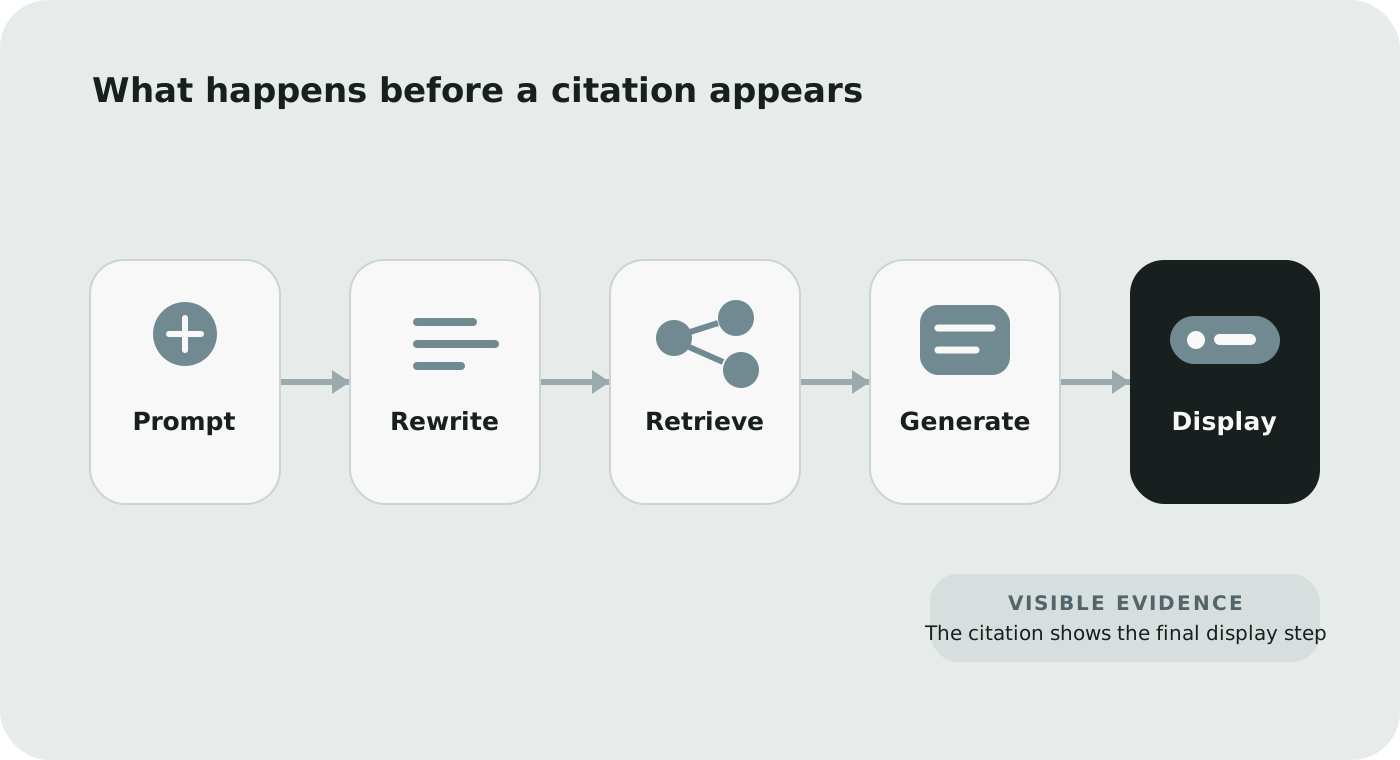
At its simplest, a citation shows that an AI search product displayed a source with an answer. Several hidden steps may have happened first. The system may decide to search the web, rewrite the request and gather possible sources before creating an answer and choosing which links to show.
Google says AI Overviews and AI Mode may use query fan-out. Put simply, the system can turn one question into several related searches across different topics and sources. The two features can also use different models and methods, so their answers and links may vary. Guidance on AI search features explains the process in more detail.
OpenAI says ChatGPT Search may also rewrite a prompt into one or more focused searches. It then returns an answer with source links. Its guide to ChatGPT Search explains how those citations appear.
The visible citation sits at the end of this chain. It doesn’t reveal each choice made along the way, but it does confirm that a source reached the final answer. That makes it useful evidence, as long as we don’t ask it to explain the whole process.
What citations can tell us
Confirm that a source appeared
The safest claim is that a page appeared in a recorded response. That statement may sound modest, but it gives the analysis a firm starting point. Repeated tests can reveal patterns when the prompt, time, product and setting stay attached to each result.
For example, testing may show that:
- a domain appears more often for one type of prompt;
- one page is often chosen for a certain topic;
- platforms tend to favour different sources;
- citation rates change after a major site update.
These findings become useful because someone else can see exactly what was tested. Remove that context and the same figures become much easier to overstate.
Show whether the result repeats
One response is only one example. Repeating the same test gives a clearer view of whether the result is stable. A source that appears several times may point to a repeatable pattern, while a changing source list tells us the result is less settled.
This is why a simple ‘cited or not cited’ score can mislead. It turns a set of changing results into one fixed state.
Point towards gaps worth checking
Citation data can guide the next stage of an audit. If other sites appear and yours doesn’t, ask:
- Can search systems crawl and index their pages more easily?
- Do their pages answer a different reading of the prompt?
- Do they give clearer facts, definitions or comparisons?
- Was your page retrieved but not shown?
- Did the system cite a page that summarised the original source?
A citation can point towards a possible gap. It can’t tell you which explanation is correct, so the next step is to test those possibilities rather than copy whatever the cited page appears to be doing.
What citations can’t tell us on their own
Why a source was selected
A citation doesn’t reveal why the system chose it. Relevance, freshness, clear evidence or ease of access may all have played a part. Without a controlled test or private system data, choosing one cause is guesswork.
This matters when a competitor’s citation gets turned into a list of actions. The cited page may contain a table, short paragraphs or structured data, but its appearance doesn’t prove that any one feature caused the citation.
Whether a source supports the answer
Showing a citation and supporting a claim aren’t the same thing. A linked page may discuss the topic without proving the sentence beside it. In one study of four generative search engines, citations fully supported 51.5% of generated sentences. The researchers also found that 74.5% of citations supported the sentence linked to them. The study of citation support explains the method and results.
Those figures don’t describe every current AI search tool. They do show why citation counts and factual support need separate checks.
How much a source shaped the answer
A page may appear as a link without shaping much of the answer. The reverse may also happen, with a source influencing the response but receiving no clear citation.
A 2026 preprint describes this as citation selection versus citation absorption. In other words, it asks two separate questions. Was the source shown? Did its words, facts or structure shape the answer? The proposed way to measure this is an early attempt to track that difference.
The terms are useful even though the measures aren’t standard yet. They remind us that being shown and shaping an answer are two different things.
Whether visibility will remain stable
Generated answers can change with wording, follow-up questions, location, product, account settings, model updates and time. A citation seen today isn’t a fixed ranking. It’s a dated result from a changing system.
Past results also need context. If the prompts, platform or test setting changed, the measure changed too.
Whether the citation created value
A visible source isn’t the same as a visit, sale or rise in trust. Someone may see the link and never open it, while another page may earn fewer citations but send more useful visitors.
Citation data should sit beside referral traffic, conversions and brand research. It shouldn’t replace them.
A clearer way to measure AI visibility
Instead of squeezing AI visibility into one score, split the measurement into five layers. Each layer answers a different question and stops one positive number from hiding a weakness elsewhere.
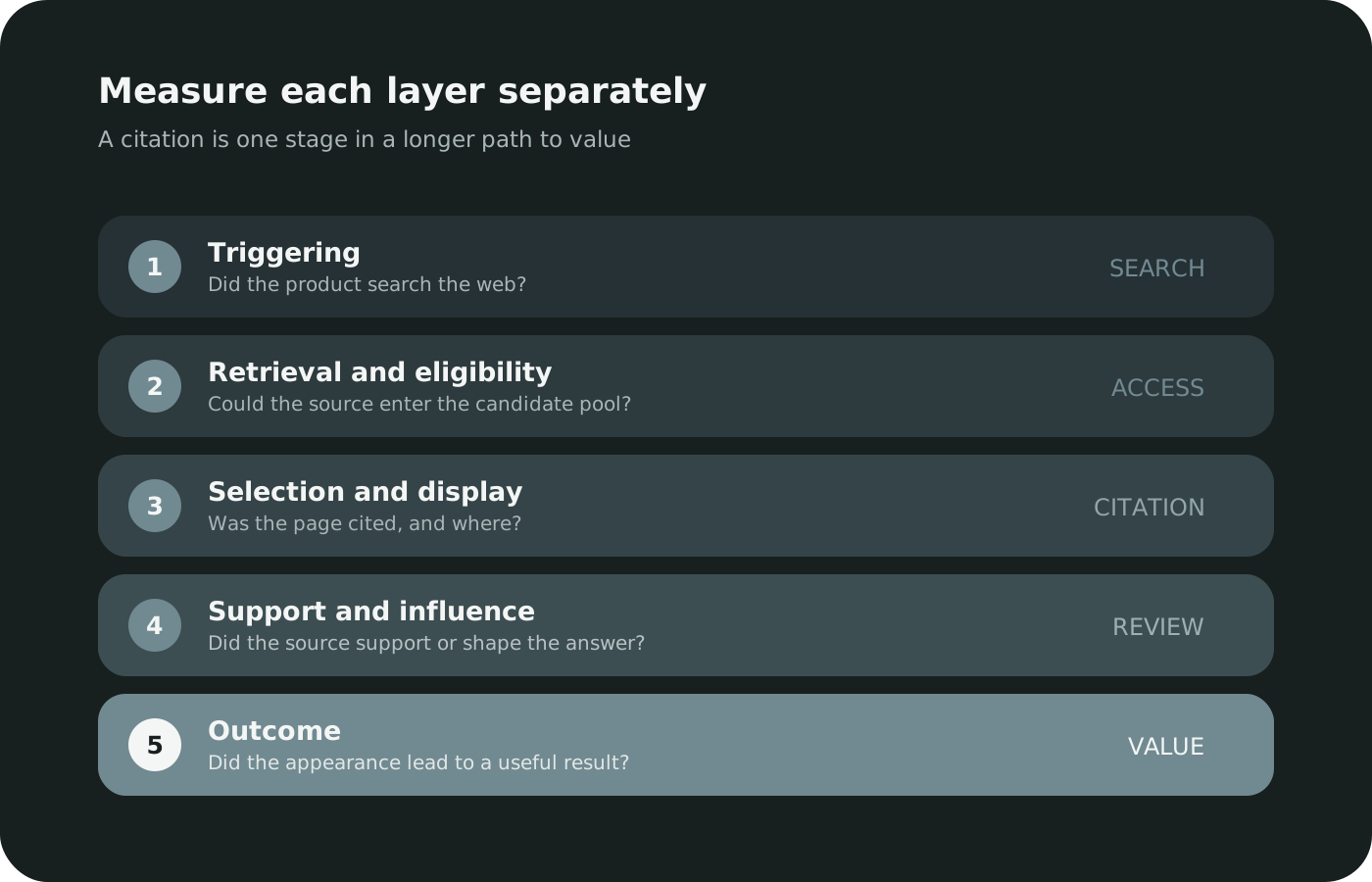
1. Triggering
First, did the product search the web or show a search-based answer?
Keep tests that didn’t trigger search in the record and report them separately. This keeps the full prompt set visible while making it clear which tests gave the system an opportunity to show citations.
2. Retrieval and eligibility
Next, could the source enter the pool of pages that the system might use?
Different platforms use different routes to discover and retrieve pages:
- Google says pages must be indexed and eligible to show a search snippet before they can appear as links in its AI search features. Its technical requirements for AI features don’t add a separate AI crawler.
- OpenAI advises site owners to allow
OAI-SearchBotif they want pages to appear in ChatGPT Search. Its guidance for site owners separates this search crawler from the bots used for model training. - Perplexity recommends allowing
PerplexityBotand its published IP ranges so a site can appear in its search results. Its crawler documentation also separates search discovery from model training.
Technical access doesn’t guarantee a citation. It only confirms that the page had a chance to be considered. A blocked or ineligible page is still a technical issue, not proof that the system disliked the content.
The Search Appearance Lab shows how one hypothetical page can move from being the destination in a traditional result to a supporting source in several AI search experiences. Its examples illustrate possible presentation patterns, not whether a real page will be selected.
3. Selection and display
Was the domain or page cited, and where did the link appear?
Useful fields include:
- the cited domain and URL;
- the place and type of citation;
- whether it appears inline or only in a source list;
- whether the answer names the brand;
- whether the link points to the original source.
4. Support and influence
Does the page support the linked claim, and is there any sign that it shaped the answer?
This stage needs human review. Automated text matching can help sort a large set of results, but it shouldn’t replace checking the claim against the source.
5. Outcome
Finally, did the citation lead to a useful result?
That result may be a visit, an assisted sale or more branded searches. Some effects will be hard to connect to one citation. Keeping outcomes separate stops citation volume from posing as business value.
A practical test method
The aim isn’t to remove all doubt. It’s to record each test clearly enough that the results can be compared without pretending they say more than they do.
Define the question first
The question ‘How visible are we in AI?’ is too broad because it leaves the platform, audience and measure undefined. A more useful question could be:
Across 40 non-branded prompts linked to our main service, how often does ChatGPT Search cite our domain during four weekly tests?
This version sets the platform, prompt set, schedule and measure. Someone reading the report can now understand what the percentage covers.
Record the test conditions
For each result, save:
- the exact prompt and earlier chat context;
- date, time and rough location;
- product and screen tested;
- account state, where it may affect the answer;
- whether web search was used;
- the full answer and source list;
- cited URLs, brand mentions and display order;
- key changes between repeat tests.
Screenshots help when a result needs to be checked later, while a spreadsheet makes the full set easier to compare. A useful row might contain one prompt, one test date, whether search triggered, every cited URL and a short note on whether the source supported the answer.
Repeat tests without false precision
Repeat tests help show change, although a large set of automated prompts won’t always reflect what real people ask.
Build the prompt set from genuine audience needs, such as sales questions, support queries, Search Console data or interviews. Review it when products or search habits change, then report the sample and method with each result. This stops one percentage being read as a universal score.
Keep each metric separate
A compact report could include:
- Count how many tests produced a search-based answer.
- Track how often the domain appeared across valid tests.
- Break that citation rate down by URL.
- Record how often the same source appeared again.
- Review whether each cited source supported the linked claim.
- Track visits and useful actions where referral data is available.
Avoid blending these into one private visibility score. If you do create a combined score, show its parts and explain the weighting.
How to report results with care
Good reporting makes it harder to confuse one observation with a general rule. Instead of saying:
Your AI visibility is 62%.
Give the reader the test boundaries:
Your domain appeared in 62% of 160 ChatGPT Search responses. The test covered 40 prompts, checked once a week during July. Results changed often for 11 prompts. Citation support was reviewed on its own.
The second version takes a little longer to read, but it gives the percentage a clear boundary. A client can see what changed, what stayed stable and how much confidence to place in the result.
The right role for citation tracking
AI citation tracking is useful when it’s treated as evidence from a defined test. It can show where sources appear, reveal change and point to questions worth exploring. It becomes misleading when a visible link is treated as proof of cause, support, stable rank or business value.
The goal isn’t to collect the largest possible citation count. It’s to keep enough context to know what each citation can and can’t support. That gives teams something more useful than an impressive dashboard number: a view of AI search visibility they can explain, question and act on.